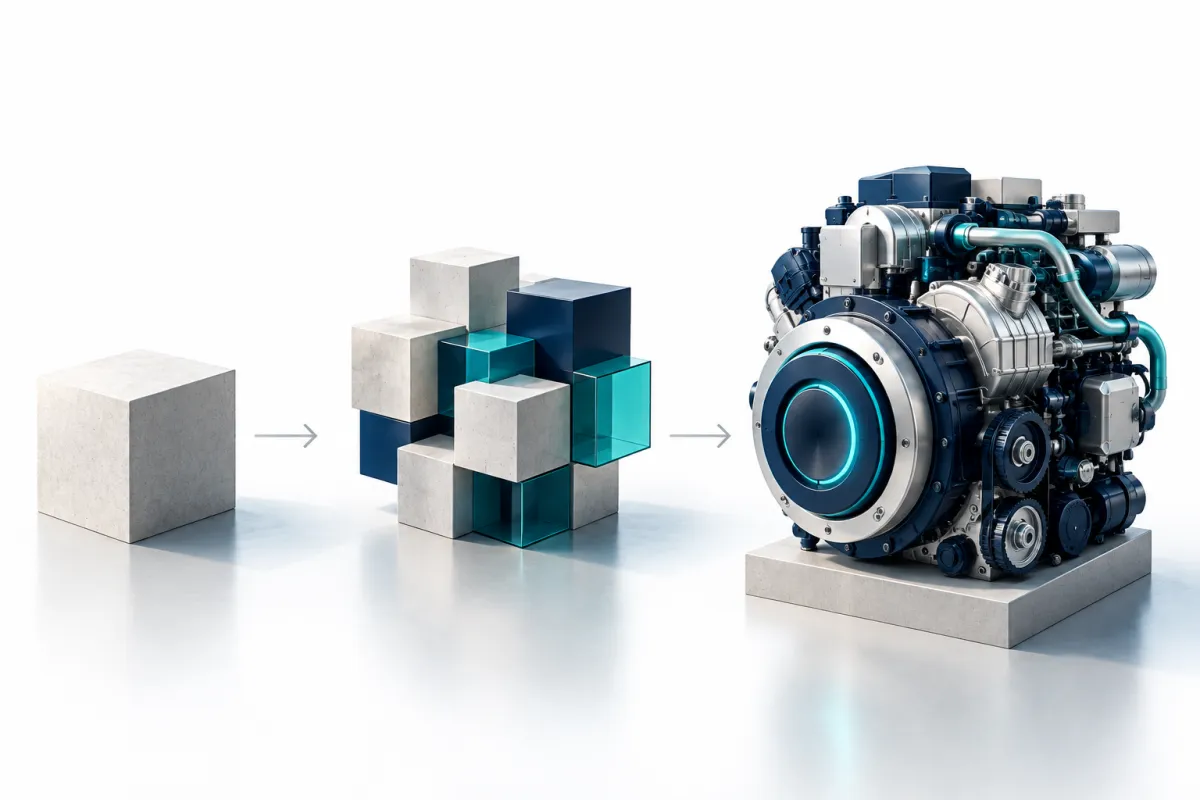
From Ideas to Engines: The Shift That Matters
Why great ideas aren't enough—and what it takes to build businesses that create lasting value.
By Alain Leroy | Venture Architect
Ideas are everywhere.
Engines are rare.
Over three decades, I've worked with organizations ranging from emerging ventures to global enterprises. I've helped build technology systems, lead transformation initiatives, develop growth strategies, and navigate the realities of building businesses.
Across those experiences, one observation has stayed with me.
The organizations that succeed aren't necessarily the ones with the most original ideas.
They're often the ones that figure out how to turn those ideas into something that works—consistently, repeatedly, and eventually, at scale.
I've also experienced the other side of that equation.
Building a venture forces you to confront the distance between what you envision and what you can actually execute.
A compelling idea can generate enthusiasm. It can attract attention, partners, and even investment.
But enthusiasm doesn't deliver products. Attention doesn't create customers. And investment doesn't automatically produce a sustainable business.
Something has to connect the idea to the outcome.
Ideas create possibilities. Systems create capacity. Engines create lasting value.
Understanding that progression changes how we approach building.
The Trap Most Founders Don't See
Entrepreneurship celebrates ideas.
We celebrate the breakthrough concept, the innovative business model, and the founder who sees an opportunity others have overlooked.
Those moments matter.
But an idea is only the beginning.
I've encountered talented founders who could describe their vision with remarkable clarity but struggled to explain how their business would consistently acquire customers, deliver value, or generate sustainable revenue.
That doesn't mean the idea was flawed.
It means the venture was still incomplete.
The challenge is that early enthusiasm can disguise this distinction.
A founder develops a concept, builds a presentation, receives encouraging feedback, and begins pursuing funding.
But the harder questions remain unanswered.
What happens when demand increases?
How does the business deliver consistently?
And what happens when the founder can no longer personally manage every important decision?
These aren't questions to postpone until the business grows.
They're part of what makes growth possible.
The Shift From Ideas to Engines
I've come to think about venture building through three distinct concepts.
An idea represents possibility.
It identifies an opportunity, a problem worth solving, or a different way of creating value.
A system creates repeatability.
It connects people, processes, technology, and resources so an organization can deliver on its promise consistently.
An engine creates momentum.
It brings those systems together in ways that allow the organization to produce value, learn, improve, and grow.
The distinction may sound simple.
But it represents a fundamental shift in how we think about entrepreneurship.
Consider a founder who has built a successful consulting practice.
Initially, the business may depend almost entirely on that founder's relationships, expertise, and personal effort.
The business generates revenue. Clients are satisfied. Opportunities continue to emerge.
But what happens when the founder wants to serve ten times as many clients?
More ambition won't solve that challenge.
Neither will simply working longer hours.
The business needs a different architecture.
That's the shift from having something that works because of the founder to building something that works through the organization.
The goal isn't simply to build a successful venture. It's to build a venture capable of sustaining success.
Why Systems Thinking Matters
My early career in technology taught me that a system is more than a collection of components.
Its value comes from how those components work together.
You can have excellent technology, talented people, sufficient funding, and a promising strategy.
But if those elements aren't connected, the organization can still struggle.
I've seen this in large enterprises.
And I've seen it in emerging ventures.
The scale may differ, but the underlying challenge is often similar.
The pieces exist.
The architecture doesn't.
This is why I increasingly think about entrepreneurship through the lens of venture architecture.
Not simply what a founder wants to build, but what must exist around that vision for it to become sustainable.
It's also one of the ideas behind Venture Philanthropy Blueprint.
Capital matters. But so does the capacity to deploy it effectively and the community that creates access to opportunity.
The real opportunity is connecting these elements into something greater than their individual contributions.
What Changes in the AI Era?
Artificial intelligence and automation are changing what it takes to build a business.
Capabilities that once required substantial teams, specialized expertise, or expensive infrastructure are becoming more accessible.
For founders operating with limited resources, that's significant.
But technology introduces an important distinction.
Automating a broken process doesn't create a better business. It can simply make the problems happen faster.
AI can help organizations become more capable.
It can reduce repetitive work, improve access to information, and support better execution.
But it doesn't eliminate the need for sound judgment, clear strategy, or thoughtful organizational design.
The opportunity isn't simply to use more technology.
It's to build better businesses with the technology now available.
And that requires us to think beyond tools.
Building What Lasts
The more time I spend working with founders, investors, universities, and entrepreneurial ecosystems, the more convinced I become that our greatest opportunity isn't simply generating more ideas.
It's developing more capable builders.
People who understand not only how to recognize opportunity, but how to turn that opportunity into functioning organizations.
People who can connect strategy to execution.
Innovation to sustainable value.
And economic success to meaningful social outcomes.
That's the work of venture architecture.
The future won't belong exclusively to those with the most compelling ideas.
It will also belong to those who can build the systems that make those ideas work.
Ideas create possibilities. Systems create capacity. Engines create lasting value.
The shift from one to the next is where building truly begins.
The Builder's Question
If you stepped away from your venture for 30 days, what would continue working—and what would stop?
The answer may reveal whether you've built a business around an idea or an engine capable of creating lasting value.
Explore the Thinking Behind the Blueprint
These ideas are part of a larger question I've spent decades exploring:
How do we build businesses that make money helping people?
In Venture Philanthropy Blueprint: Builders. Backers. Believers., I bring those experiences together into a framework for building ventures that create lasting economic and social value.